
Common Questions
Water Bore FAQs
Drilling a bore is a big decision, and most people have only done it once, if ever. These are the questions we get asked most, answered straight. If yours is not here, send it through and we will answer it.
Jump to a Topic
Can’t find your question? Ask us directly or call 1800 374 554.
Before you start
It depends on where your property is. In some areas drilling is straightforward; in others, permits or moratoriums apply. We know the regional boundaries and moratoriums, and we will explain what applies to your property and point you in the right direction.
Most of the time, a site visit isn’t necessary. We check the property details, surrounding bore history, and local rules remotely to quote your project. If access is tight or the terrain is a concern, or if you simply prefer us there, we’re happy to inspect beforehand.
To give you an accurate quote, simply fill out our online quote form with your contact details, property address, intended water use, and rig access details.
We are based in Toowoomba and travel across the Darling Downs, Lockyer Valley, Western Downs, Southern Downs, Somerset, Scenic Rim, South Burnett and the Goondiwindi region. Most of our customers are anywhere from half an hour to a couple of hours from our base of operations. If you are not sure, send us your property location and we will tell you straight.
Yes. Travis holds a Class 2 driller licence with rotary air and rotary mud endorsements, which lets us construct bores across multiple aquifers and drill using either method. We are fully insured, and we construct every bore to comply with the Minimum Construction Requirements for Water Bores in Australia (Current Version).
Cost
Stock and domestic bores generally start from around $10,000 + GST, with the final cost depending on total drilling depth and ground formations (strata). We quote each property individually, and the only accurate price is one based on your property.
While we have a solid idea of target formations and depths, we don’t know the exact final depth or strata until we drill, and the final cost also depends on the specific water yield and quality you require. We provide a reliable estimate based on nearby bore reports and experience; however, the exact price ultimately depends on what we drill through.
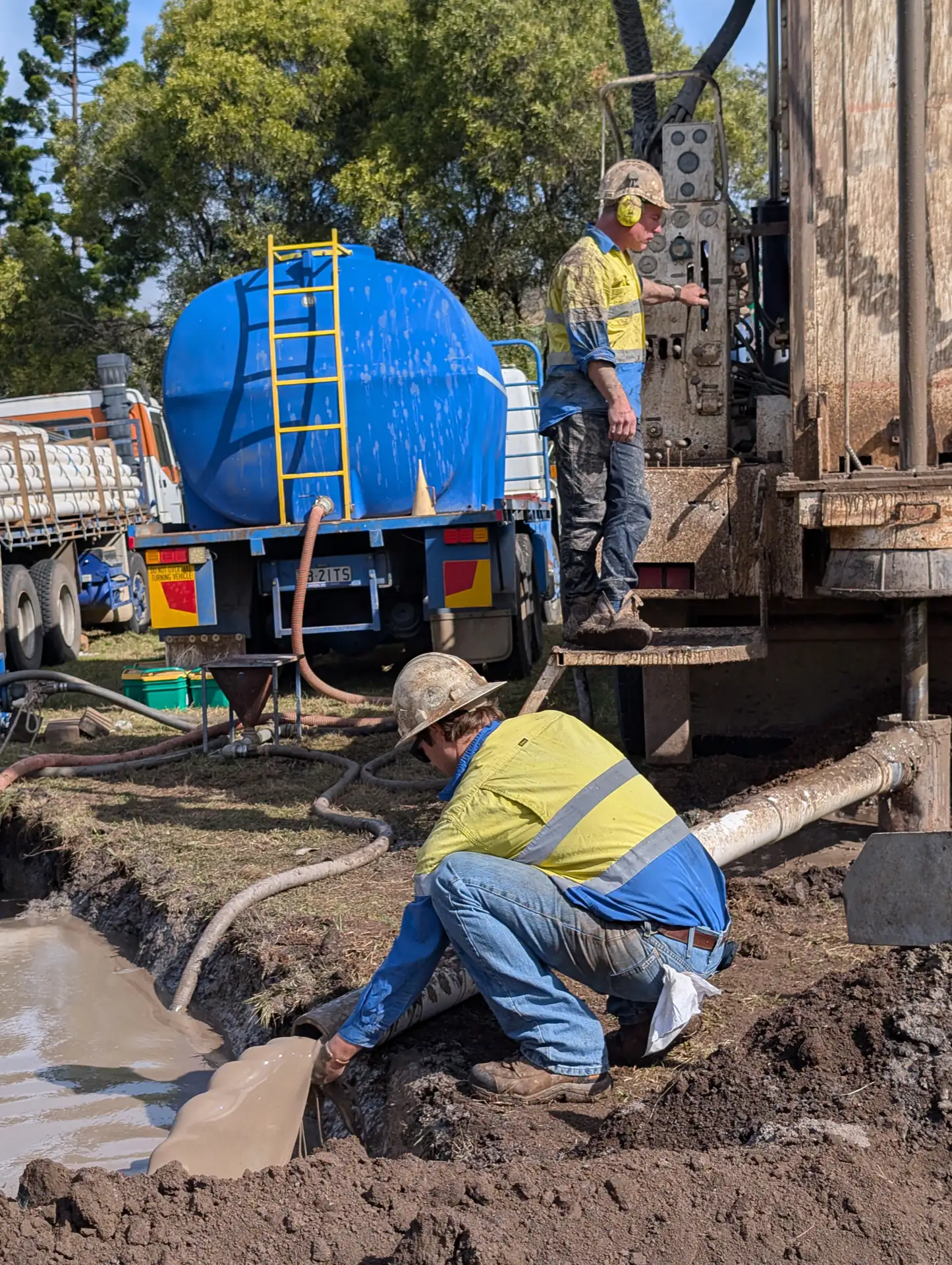
Some formations (strata) can be drilled using air, while looser country (like the alluvial areas around Dalby) requires rotary mud drilling. Rotary mud drilling needs extra equipment on site, including mud pumps, an additional truck, and an excavator to dig mud pits, along with a setup day before drilling begins. Because it’s a bigger, longer process, it costs more. We’ll always let you know if your formation is likely to require mud drilling when we provide your quote.
If you are a primary producer, a new working bore may be eligible for the Queensland Government’s Drought Preparedness Grant through QRIDA, which can cover up to 25% of eligible costs, to a maximum of $50,000 in total, excluding GST. The grant must be approved before we start drilling. We do not lodge applications, but we give you a clear, itemised quote you can use in yours. See our Government Grants & Funding page for the details.
Applications are closed for 2026-2027, and QRIDA expects the grant to reopen on 1 July 2027. Check the official QRIDA page for the current status.
Finding water
No driller can guarantee water before drilling. What we can do is give you an honest assessment of your chances based on the country and your site before you commit. We will be straight with you about the risks rather than over-promising.
We check the bore reports around your property for depths, yields, water quality and formations. Combined with our regional drilling experience, this lets us give you an honest assessment of your chances and a realistic drilling target before you commit to anything.
It depends on your location and the aquifer we are targeting. Some bores strike good water at relatively shallow depths, while others need to go much deeper. We provide our best estimate upfront, and because depth is the biggest factor in overall cost, we keep you fully informed as the drilling progresses.
Yes, our rig is fully equipped to reach the deep target of most aquifers across the region. Depth depends entirely on your location and the target aquifer, but we will give you a realistic target upfront and keep you informed every step of the way.
It comes down to the specific aquifer we intersect and its fractures. We target the kind of yields seen in nearby bores, but we always advise planning conservatively rather than expecting the area’s absolute best result. Even a low flow rate of 200 litres per hour adds up to 4,800 litres over 24 hours. See our Lemon Tree Feedlot case study for one stock bore result.
On the day
Some bores can be finished in as little as a day, while the majority take between 2 and 3 days. However, more complex jobs can take up to a week. The total timeframe depends on the underlying formations (strata), weather conditions, and the drilling method used (rotary air or rotary mud).
As for the overall timeline from your initial enquiry to a finished bore, that depends on your schedule, our current rig schedule, and when you want to proceed. We always provide a realistic timeframe upfront so you know what to expect.
We use rotary air drilling for harder rock types like basalt, granite, and sandstone. For loose or unstable ground, such as sand, gravel beds, or clays that collapse easily, we use rotary mud drilling to keep the hole stable and construct the bore correctly. We always default to air drilling whenever possible, switching to rotary mud only when required.
Absolutely, and we actively encourage it. We’ve found it’s much better to have you on site so we can explain what’s happening down the hole as we drill and answer any questions in real time. However, we understand that isn’t always practical, so as long as you are easily contactable throughout the drilling and construction phase, we can keep everything moving smoothly.
This is exactly why we give you an honest assessment before we start. We will talk you through how we handle this as part of your quote, so you go in with a clear understanding rather than a nasty surprise.
After drilling
Once the bore has been constructed in accordance with the Minimum Construction Requirements for Water Bores in Australia, it is ready to be equipped with a pump. Upon completion, we provide you with a tailored pump set recommendation, along with a list of trusted local irrigation specialists so you can compare multiple quotes.
No. We hand the bore over ready to be equipped, complete with a pump set recommendation that you can take to any pump or irrigation specialist. If you would like a recommendation, we are always happy to point you towards suppliers we trust.
Generally, yes. A secure, independent water source is a major asset for agricultural, livestock, and lifestyle properties. Many clients drill a bore before listing their property, because a property with its own water supply is more attractive to buyers.
Still Got Questions?
Ask Us Anything
If your question is not answered here, send it through and we will get back to you, or request a free quote and we will answer it with your quote. Prefer to talk? Call us on 1800 374 554, 8AM to 5PM, Monday to Friday.